Metal Roof Cladding Coating Systems
Looking to refurbish and waterproof your existing metal roof cladding? Looking for a leaking metal roof contractor your can trust to deliver? Look no…
Specialist Metal Roof Cladding Coating Systems
Looking to refurbish and waterproof your existing metal roof cladding? Looking for a leaking metal roof contractor your can trust to deliver? Look no further than Storm Coatings.
Waterproofing the metal roof cladding of your commercial or industrial building makes eminent business sense to ensure your work doesn’t suffer from roof leakages that can damage your interiors, weaken the building structure, and even lower the value of the property.
Why Choose Storm Coatings
Nationwide Coverage
Commercial and industrial roofs across the UK — single units to large estates.
No Strip-Out
Coatings applied over the existing roof — less waste, less cost, less downtime.
Up to 25-Year Guarantee
Long-life systems backed by a written guarantee.
Minimal Disruption
Cold-applied and low-odour, so you keep operating while we work.
To keep your property protected, you need to ensure that the metal roof over it is overlaid with waterproof sealant formulated specifically for specific metal roofs that will keep it free of corrosion and damage. We use metal specific protective sealants. For example, for tin roofs, we use specialist galvanized roof sealants only.
At Storm Coatings, we ensure that your metal roof protective coating is applied throughly and evenly to make it fully sealed to keep it safe from leaks and heat stress. We paint your metal roof panels for improved looks of the property.
Depending on the roof and the coating treatment selected, you receive 10 to 25 years’ guarantee on the work delivered by us. This also ensures that your metal roof coating cost per square metre pays in the longer run as you don’t have to incur cost of recoating metal roof anytime soon again.
Contact us today to discuss your metal roof waterproofing and coating requirements.
Metal Roof Coating Solutions
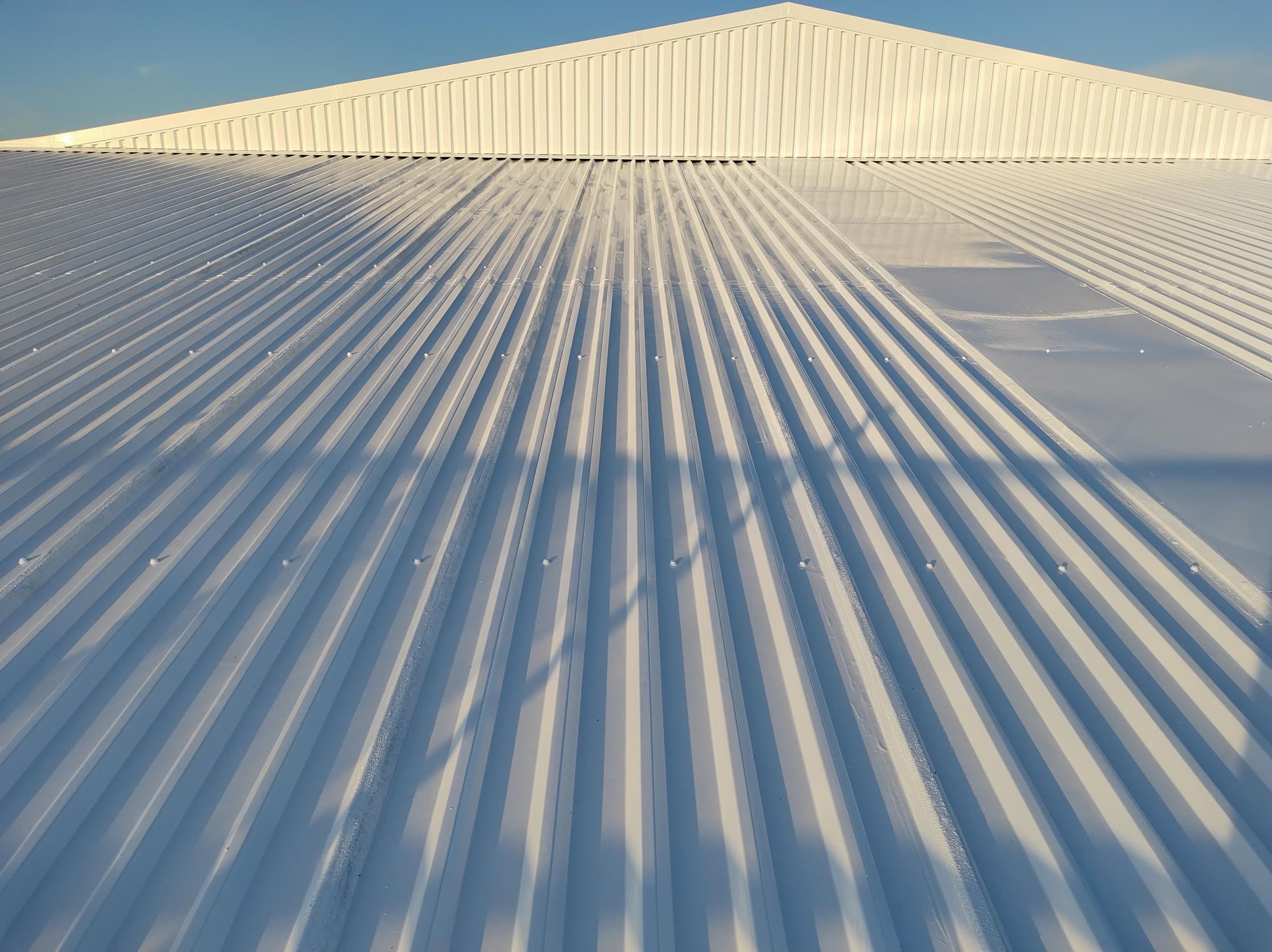
Our metal roof coating systems are formulated specifically for profiled steel and aluminium cladding. Whether you have a corrugated metal roof, trapezoidal profile, or standing seam system, we apply high-performance protective coatings that seal against moisture, prevent corrosion, and restore the appearance of weathered cladding. All coatings are applied on-site with no need to strip the existing surface.
Why Metal Roof Cladding Deteriorates
Metal roof cladding is durable, but over time exposure to UV, rain, temperature cycling, and atmospheric pollutants breaks down the original factory-applied coating. Cut edges and fixings are the first areas to show corrosion, followed by the sheet face. Without treatment, corroded metal cladding leads to leaks, structural weakening, and eventually the need for costly full replacement. A metal roof cladding coating applied at the right time can extend the roof life by 20-25 years at a fraction of the replacement cost.
Metal Roof Waterproofing Process
Our metal roof waterproofing process begins with a thorough survey to assess the condition of the existing cladding, fixings, and flashings. We then clean and prepare the surface, treat any cut edge corrosion, replace degraded fixings, and apply a multi-coat protective system. The finished coating provides a seamless, weather-tight barrier that withstands the most demanding UK weather conditions.
Frequently Asked Questions
How long does a metal roof coating last?
A properly applied metal roof coating system typically lasts 20-25 years. We use high-performance liquid waterproofing systems specifically designed for metal substrates.
Can you coat a rusted metal roof?
Yes — provided the metal is structurally sound. Surface rust is removed during preparation, and specialist primers are applied to stabilise any remaining corrosion before the waterproof coating is applied.
What types of metal roof can be coated?
We coat all common metal roof types including profiled steel sheets, standing seam roofing, composite panels, corrugated iron, and aluminium roofing. Each substrate is treated with the appropriate primer and coating system.
Will coating my metal roof stop condensation?
A roof coating alone will not solve condensation problems, as these are caused by inadequate ventilation or insulation. However, we can advise on condensation solutions as part of a roof refurbishment project.
How much does metal roof coating cost per square metre?
Costs vary depending on roof condition, access, and the coating system specified. We provide free surveys and detailed quotations. As a guide, coating is typically 50-70% less than full re-cladding.
Is Roof Coating Right for Your Building? A Practical Guide
If you’re dealing with a leaking or deteriorating industrial or commercial roof, the first question is usually whether to coat it or replace it. Replacement is expensive — often significantly so — but coating a roof that’s past the point of no return just delays the problem. This guide is written for building owners, facilities managers and property managers who are trying to work out which route makes sense before committing to anything. We’ll cover which roof types suit coating, what a proper condition assessment looks like, and the circumstances where coating simply isn’t the right answer.
Coating vs Replacement: How to Decide
The core question when weighing up coating against replacement is whether the existing roof substrate is structurally sound and capable of being sealed. A roof coating — whether a reinforced liquid membrane, an acrylic system or a specialist metal-roof coating like Elastaseal Z — adds waterproofing and protection to an existing structure. It does not restore the structure itself.
If sheeting is significantly corroded, deformed or missing fixings, replacement is likely the only viable route. But if the roof is broadly intact, watertight in most areas, and suffering from localised issues such as cut edge corrosion, failed lap joints, gutter deterioration or surface degradation, coating can extend the roof’s serviceable life by many years at a fraction of the cost of new sheeting.
For many commercial and industrial buildings, particularly those with profiled metal or fibre cement roofs, coating is a legitimate long-term solution rather than a temporary sticking plaster.
Which Roof Types Are Suitable for Coating?
Most industrial and commercial roof types can be coated, but they’re not all treated the same way.
Profiled metal sheeting — steel or aluminium — is the most common candidate. Systems like TOR UNi-cover, Delcote or Advantage 20 are specifically formulated for metal substrates and will accommodate the thermal movement these roofs experience.
Flat roofs — including felt, EPDM, GRP and aspalt decks — can be refurbished with liquid waterproofing membranes applied in layers, with reinforcing fleece.
Single-ply and built-up felt systems can sometimes be overcoated, though compatibility testing and surface prep are critical.
If you’re unsure what you have, a site visit or a photo assessment can help narrow down the options before anyone commits to specification.
Assessing Roof Condition Before Specifying a Solution
No reputable contractor should be specifying a coating system without first assessing the roof properly. For an industrial roof waterproofing assessment, the key things to check include: the condition of the laps and seams, the state of fixings and fasteners, any visible corrosion or rust bleed, the integrity of gutters and downpipes, the condition of flashings and upstands, and whether there is any evidence of water ingress from inside.
Photos are a useful starting point — and we frequently use them to give clients an initial steer before arranging a site visit — but they can only tell part of the story. A physical inspection allows the surveyor to check for soft spots, assess substrate adhesion potential, and identify issues that aren’t visible from ground level or from a drone image.
A proper condition survey produces a clear picture of what’s failing, where, and why. That’s what a specification should be based on.
Coating Metal Roofs: Flashings, Gutters and Penetrations
One of the most common enquiries we receive is from building owners dealing with leaks around flashings, gutters and roof penetrations on an otherwise serviceable metal roof. These details are often the first to fail — sealant shrinks and cracks, flashing fixings corrode, gutter joints open up under thermal movement.
A coating system applied across the main roof area without addressing these details will not solve the problem. Flashings on metal roof abutments can be over-coated or re-dressed using compatible sealants and reinforcing fabric prior to the main application. Gutters can be relined using a system such as Plygene Gutterline and liquid systems which provides a waterproof lining inside the existing gutter without needing to rip out and replace the whole drainage run.
Penetrations — rooflights, pipework, vents — need to be treated individually with appropriate collars or termination details. A well-specified coating job treats the whole roof as a system, not just the roof sheets in between.
Safety Considerations for Roof Access and Application
Working at height on an industrial or commercial roof requires a structured approach to access and fall protection. Before any survey or application work begins, a risk assessment and method statement (RAMS) should be in place.
For fragile roofs — which includes many older profiled sheeting installations — work must be planned around the use of crawling boards, roof ladders and perimeter protection. Asbestos cement roofs carry additional requirements because the sheets can fail without warning under load.
Where roofs are in regular use for maintenance access, clients sometimes ask about installing permanent safety systems alongside the coating work. This is worth considering at the specification stage rather than retrofitting later.
For occupied buildings — schools, hospitals, food production units — out-of-hours working and dust or odour control may also need to be factored in. These are operational details that affect programme and cost, and they should be discussed upfront rather than discovered during the job.
When Coating Is Not the Right Answer
Honest advice here matters. There are situations where recommending a coating would be doing the client a disservice.
If a significant proportion of the sheets are corroded through, or if the roof structure itself has been compromised by water ingress over a long period, coating is not a viable solution. Applying a membrane over rotten timber, delaminated insulation or structurally compromised purlins is money wasted.
Similarly, if a building is being redeveloped, its use is changing substantially, or a full refurbishment is planned in the short term, the economics of coating versus replacement shift considerably.
There are also cases where the specification required — for example, full thermal upgrade to current Building Regulations standards — simply can’t be achieved by coating alone. In those situations, the right answer is insulated replacement sheeting, and it’s better to say so clearly than to oversell a partial solution.
Next Steps: Get a Professional Assessment
If you’re trying to work out whether roof coating is worth it for your commercial building, or whether you’re better off planning for replacement, the most useful first step is a proper assessment — not a sales call.
We carry out roof surveys across the UK, working from our Norfolk base but covering East Anglia, the Midlands and beyond. In many cases we can give an initial view based on photos and a brief description of the issues, which helps filter out the jobs where coating clearly isn’t suitable before anyone wastes time on a site visit.
If your roof is worth coating, we’ll tell you what system suits it and why. If it isn’t, we’ll tell you that too. To arrange a survey or send across photos for an initial assessment, contact us through the website or call the office directly.
Frequently Asked Questions
Can you give a rough cost indication without visiting the site? In some cases, yes. If you can provide photos, the roof area, sheet type and a description of the main issues, we can often give a ballpark range to help with budget planning. A firm quote always requires a site visit, but a photo assessment is a useful starting point.
How do I know whether my roof is asbestos cement? Older fibre cement roofing, typically installed before the mid-1990s, is likely to contain asbestos. If you’re unsure, don’t disturb it. An asbestos survey by a licensed consultant will confirm the presence and type. We work regularly with asbestos cement roofs and can advise on encapsulation options once you have a survey report.
What’s the difference between a coating and a full liquid waterproofing system? A basic coating is typically a single or two-coat application that improves weatherproofing and extends surface life. A liquid waterproofing system — such as a reinforced cold-applied membrane — involves multiple layers, usually including a reinforcing fleece, and is designed to provide a fully bonded waterproof membrane with a defined service life. The right choice depends on the roof condition, the level of protection needed, and the budget available.
Metal Roof Coating Systems: Protection, Warranties & Specifications
A large metal roof is a significant asset — and when it starts to fail, the consequences are expensive. Corrosion spreads quickly once a coating breaks down. Lap joints weep. Sheet fixings rust through. If there’s a solar array sitting on top, the complexity increases further, because standard repair approaches can compromise the installation or void equipment warranties. This page covers the coating systems we use for commercial and industrial metal roofs across the UK, what specifications look like at scale, and how warranty-backed options work in practice.
Why Metal Roofs Need Specialist Coating Systems
Profiled metal roofing — steel or aluminium, standing seam or corrugated — behaves differently to felt, single-ply or built-up flat roofing. It expands and contracts with temperature. It corrodes at fixings, overlaps and cut edges. Factory coatings degrade over time, leaving bare metal exposed to weathering.
A general-purpose paint won’t hold. A metal roof coating system UK contractors should be specifying uses primers engineered for steel or aluminium substrates, reinforced membranes and for seam and detail work, and elastomeric topcoats that flex with the sheet movement rather than crack under it. The sequence matters as much as the individual products. Getting primer adhesion right on a prepared metal surface is the foundation everything else depends on.
Common Problems: Corrosion, Sheet Protrusions and Lap Joints
Three areas account for the majority of metal roof failures we’re asked to address.
Corrosion at fixings and cut edges is the most common. Where a fixing penetrates the sheet, moisture tracks down the screw shank and begins oxidising the surrounding metal. Left untreated, this spreads across the sheet face. Cut edge corrosion treatment — cleaning back to sound metal, applying a specialist primer and reinforced coating — stops that process before it spreads.
Lap joints between sheets are a reliable ingress point. The original mastic or sealant dries out and cracks, and wind-driven rain works its way into the overlap. These need re-sealing and taping before any topcoat goes on.
Sheet protrusions — rooflights, vent upstands, pipe collars — are high-risk details. We reinforce each protrusion with glass-fibre matting and liquid membrane before coating, because this is where a failed system almost always traces back to.
Coating Metal Roofs with Solar Panel Installations
This is a question we get asked directly, and it’s a situation most roofing contractors don’t address explicitly. If you have a photovoltaic array installed on a metal roof, the roof coating work becomes considerably more involved.
The panels need to be lifted or worked around carefully to ensure coating reaches the full roof surface underneath, including the shadowed areas where moisture sits. Bracket penetrations — the fixings that hold the racking system — are critical sealing points. Each one needs treating individually: clean metal, compatible primer, reinforced liquid membrane flashing. The coating system also needs to be compatible with the panel manufacturer’s requirements, as some warranties specify restrictions on chemical contact.
For metal roof coating under solar panels in the UK, we plan the work in sections, work with the system racking where possible, and document the specification in a format suitable for handover to the solar equipment owner. If you’re a facilities manager or building owner with a panelled roof that’s approaching maintenance, this is something to address before problems develop underneath the array — at that point, remedial work is substantially more disruptive.
System Specifications: What a Quality Metal Roof Coating Includes
A properly specified metal roof coating system in the UK typically runs to four defined stages.
Preparation — pressure washing, rust treatment, mechanical cleaning at severe corrosion points. Adhesion depends entirely on surface preparation. Any areas of loose or delaminating factory coating are stripped back.
Primer coat — product selected to suit the substrate (steel, galvanised steel, or aluminium all require different chemistries). This coat locks down existing rust inhibitors and provides a bond for the build coats.
Reinforcement at details — lap joints, protrusions, gutters, ridge flashings and any penetration receives glass-fibre reinforcement embedded in liquid membrane before any topcoat is applied.
Topcoat system — typically two coats of elastomeric roof coating, such as Uni-cover ultra or equivalent, applied to the specified film thickness. Colour options are available; light grey and white are common for reflectivity on industrial roofs.
Coating a corrugated metal roof in the UK requires attention to the profile valleys — these hold water and must be fully covered to the correct wet film thickness.
Warranty Options Up to 25 Years
Warranty-backed metal roof coating is available and is increasingly specified on public-sector and main-contractor projects. What a warranty actually covers depends on the system manufacturer, the surface preparation standard achieved, and the coating thickness verified on completion.
For projects requiring a 25-year warranty metal roof coating, the specification becomes tighter — more stringent surface preparation, additional inspection stages, manufacturer involvement in quality sign-off, and documented film thickness readings. We can work to specifications that meet these requirements and produce the paperwork needed for tender or building owner handover.
Shorter warranty periods — — are also available and may be more appropriate for older structures where the substrate condition limits what can be guaranteed. We’ll advise honestly on this during the survey stage rather than over-specify a warranty the substrate can’t support.
Estimating Quantities for Large Metal Roof Projects
For roofs of 800 square metres and above, pricing is done properly — a site survey, measured drawings or verified take-off, and a written specification rather than a per-square-metre estimate given over the phone.
At this scale, the variables that affect price are significant: degree of corrosion across the sheet, number of rooflights and protrusions, access requirements (MEWP, scaffolding, harness working), whether any re-sheeting is needed before coating, and whether a manufacturer warranty is required. A site visit resolves all of these.
We regularly tender metal roof coating projects at scale alongside main contractors and directly for building owners. If you need a specification and programme for tender purposes, we can provide that in a format suitable for submission.
Request a Metal Roof Coating Survey
If you’re managing a large commercial or industrial metal roof — whether it needs immediate attention or you’re planning ahead — the most useful first step is a roof survey. We’ll assess the substrate condition, identify problem areas, and set out a coating specification that suits the building and your budget.
We cover the UK from our Norfolk base, with regular work across East Anglia, the Midlands, and further afield. For large projects, we’re experienced with the tendering process and can provide documented specifications and method statements.
Contact Storm Coatings to arrange a survey, or send through your roof dimensions and we’ll discuss the project before visiting.
Frequently Asked Questions
Can you coat a metal roof that already has a solar panel system installed? Yes — we’ve worked on metal roofs with PV arrays and address the bracket penetrations and under-panel areas as part of the specification. The work requires careful sequencing and the right primer chemistry at fixing points, but it’s entirely achievable.
What size of metal roof project can you handle? We regularly work on roofs from a few hundred square metres up to several thousand. For large projects we carry out a full measured survey and provide a written specification, and we can tender directly alongside main contractors.
Is a 25-year warranty realistic for an older metal roof? It depends on the substrate condition. On a structurally sound roof with manageable surface corrosion, a long-term warranty-backed system is achievable. On a roof with severe section loss or significant delamination, we’ll tell you honestly that a shorter warranty or partial re-sheeting is the more appropriate route.
CONTACT US
Got a question or want a quote? Fill in the form below and we’ll be in touch..
LOCATION
38 Whitsands Road Swaffham
Norfolk United Kingdom PE37 7BY
Norfolk United Kingdom PE37 7BY
CALL US
01760 613186
EMAIL US
info@stormcoatings.co.uk
Our Process
1
Site Survey
We assess substrate, detailing, upstands and penetrations.
2
Specification
A system specified to suit your roof and any consultant spec.
3
Written Quote
A clear, documented quote for board or budget sign-off.
4
Installation
Cold-applied and seamless, around your operation.
5
Guarantee
A written guarantee of up to 25 years on completion.
Get a Free Roof Survey
No-obligation site visit, condition assessment and written quote.
Specialist commercial & industrial roof coating contractors based in Swaffham, Norfolk.
Services
Flat Roof Refurbishment
Metal Roof Coatings
Cladding Spraying
Cut Edge Corrosion
Gutter Systems
Asbestos Waterproofing
Company
Home
About Us
Case Studies
Areas We Cover
FAQs
Contact
Get in touch
38 Whitsands Road,
Swaffham, Norfolk
PE37 7BY
01760 613186
info@stormcoatings.co.uk
© 2026 Storm Coatings Ltd. All rights reserved. | Site by Anglia Computer Solutions.